- Services
-
References
-
Product solutions
- Reference precision angle encoder
- Reference intelligent hot air shower
- Reference intelligent beauty sprayer
- Reference intelligent lunchbox
- Reference sanitary application with HF technology
- Reference urinal flushing with HF technology
- Reference Auracast™ TV Streamer
- Reference touch-based biometric terminals
- Reference intelligent cutting board
- Reference intelligent e-charging station
- Reference Powersave
-
Product solutions
- Company
- Career
- Contact




A product journey through the Alpine Innovation Hub
Through a comprehensive product journey, this section illustrates how STEINEL Solutions develops, industrialises and manufactures a system suitable for series production from individual components. The focus is on structured collaboration between development, production engineering, procurement and manufacturing, complemented by clearly defined responsibilities and robust processes.
A comprehensive approach from concept to production
The aim is not to view a product’s journey in isolation from the perspective of individual manufacturing steps, but rather as a coherent technical and organisational process.
Decisions regarding components, processes and testing concepts are made throughout this chain, always with a view to mass-production suitability, cost-effectiveness and sustainability across the entire product lifecycle.
Technical infrastructure forms the basis for this, but systematic integration is crucial.
At STEINEL Solutions, the product journey follows a clear principle: technical and organisational decisions made early on significantly determine subsequent stability in series production. For this reason, the company adopts an integrated approach in which material availability, technological dependencies, manufacturing processes and testing strategies are assessed not sequentially but in parallel. Changes in the market environment, such as allocations, obsolescence or economic fluctuations, are incorporated into the planning not as exceptions but as fixed constraints.
Early decisions lay the foundations
The starting point of the product journey is not in production, but in the quotation and project definition phase.
It is at this stage that the key foundations for subsequent series production are laid. Technically sound quotations go beyond mere pricing and take into account the actual feasibility of a product under real market conditions.
This early assessment takes into account, amongst other things, material availability, risks associated with component selection, possible alternatives and time constraints. Technological dependencies and potential bottlenecks are also identified. The aim is to provide the customer with a robust basis for decision-making that not only works in the short term but is also sustainable in the medium and long term.
STEINEL Solutions deliberately assumes the role of a technical partner during this phase. Issues relating to design robustness, the validation of critical components or external influencing factors are addressed at an early stage. The product journey therefore does not begin with a production approval, but with a joint technical assessment, from which realistic timelines, stable concepts and clear expectations are developed.
Particularly in times of increasing economic uncertainty, proximity to the customer and mutual trust are becoming ever more important. Transparent communication, realistic assessments and a shared understanding of risks and opportunities form the basis for a resilient partnership. Building on this technical and collaborative coordination, the next step in the product journey follows: the order, as a deliberate decision in favour of a solution that is sustainable in the long term.
Production engineering brings together product and process
A key prerequisite for these well-informed decisions is the close collaboration between sales, purchasing and project management with production engineering. At STEINEL Solutions, these functions do not operate as separate units, but as an integrated team with clearly defined responsibilities and short lines of communication. As a result, decisions are not based on a single perspective, but on technical feasibility, economic conditions and project-specific requirements.
Production engineering, with its focus on new products, plays a key role in this regard. New assemblies and systems are analysed at an early stage to assess their suitability for series production. Test concepts, manufacturing processes and potential bottlenecks are taken into account as early as the quotation and planning phase. This enables risks to be identified at an early stage and managed effectively before they become entrenched as the product journey progresses.
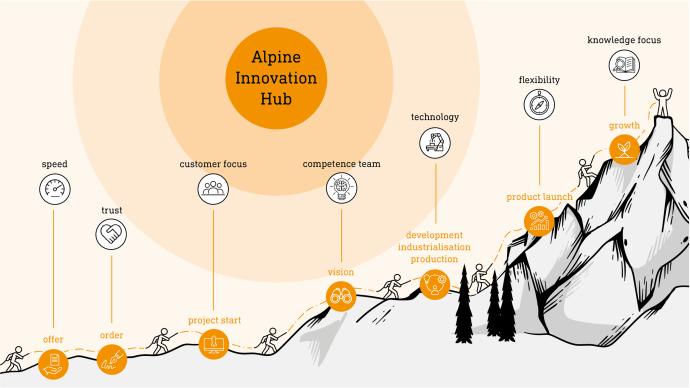
The product journey at the Alpine Innovation Hub: from the proposal stage through to series production – every step is closely interlinked.
Cooperation creates security
Agility meets implementation expertise
This structured collaboration creates certainty for both sides. For customers, because decisions are transparent and robust. For STEINEL Solutions, because new products are designed from the outset to ensure reliable implementation. Trust is built not through promises, but through consistent technical reasoning and realistic assessments. This gives rise to partnerships that endure beyond individual projects and form the basis for successful mass-produced products.
A defining feature of STEINEL Solutions is the careful balance between a sensibly scaled company size, a broad range of technological capabilities – in line with a one-stop-shop approach – and the resulting agility. The organisation is large enough to reliably manage complex development and manufacturing projects, whilst remaining flexible enough to respond swiftly to new requirements. This combination enables short decision-making processes and a high level of technical responsiveness throughout the entire product journey.
Clear roles ensure implementation
Clear processes from order placement to series production
The division of roles is deliberately kept clear. The project manager ensures structure and clarity, whilst production engineering works both on the product side – with regard to functional scope, testability and suitability for series production – and on the process side – with a focus on machinery, production line concepts and stable manufacturing parameters. This clear division of responsibilities prevents the technical focus from being lost and creates a robust link between the product concept and the realities of manufacturing.
Immediately following the order, implementation takes place in accordance with clearly defined structures, which are deliberately managed in an agile manner. A key starting point is the procurement of the required components. Even before the final order is placed, components are systematically analysed, including with regard to service life, end-of-life risks and possible substitution scenarios. This enables potential bottlenecks and subsequent development risks to be identified and avoided at an early stage. Thanks to our in-house development and engineering expertise, we can provide targeted support and relieve the burden on customers where necessary.
The physical product journey begins with the approval of the bill of materials. Components sourced from international procurement markets arrive in Einsiedeln, where they are stored in an organised manner and inspected upon receipt. An automated inspection system is used for this purpose, which captures relevant label information and assigns it unambiguously. Material quality, traceability and data consistency are thus ensured from the outset and form a solid foundation for the subsequent stages. From this point onwards, overall coordination rests with the project manager. They guide the product through the next stages of development and ensure that deadlines, deliverables and responsibilities are aligned. In parallel, production engineering takes charge of technical management. Test concepts, test equipment and manufacturing processes are defined, evaluated and continuously refined.
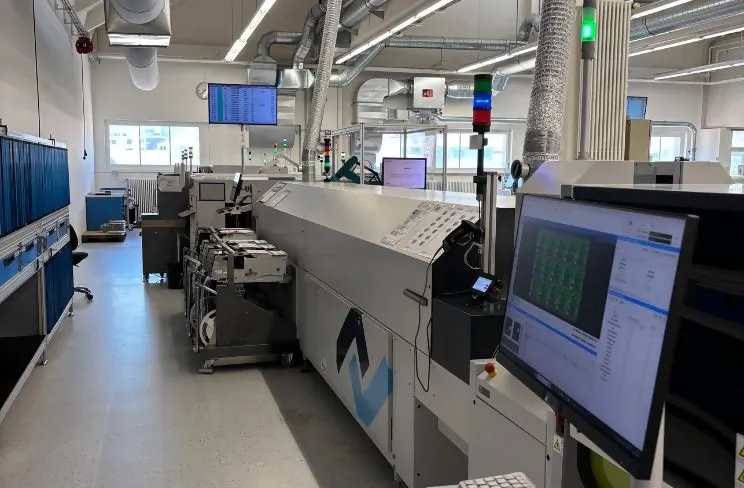
SMD manufacturing
The product journey thus leads directly to the first actual production station: SMD assembly. At STEINEL Solutions, this is designed as a fully integrated line featuring state-of-the-art placement robots. The line includes paste printing, paste inspection, laser marking for unique identification, and automatic optical inspection. All the process steps required for stable, reproducible and traceable SMD production are integrated. It is at this stage that it first becomes clear that the product is embedded in a technically fully equipped environment that is consistently focused on quality.
Following SMD assembly, various inspection and test strategies become available, depending on the product’s stage of development, the planned production volume and the quality requirements. Integrated circuit tests or functional tests enable early assessment of electrical and functional quality. In early development phases or for smaller production runs, a flying probe test is frequently used, particularly when the design has not yet been fully finalised. The choice of test strategy is always made in close consultation with the customer and is based on the actual benefits for the product and production run.
Process reliability and product-specific design
Targeted product support remains a key element in this process. At STEINEL Solutions, devices are not merely guided through standardised processes, but are actively supported. Particularly with complex products, numerous influencing factors can compromise subsequent series production success if they are identified too late. A test strategy tailored to specific requirements plays a significant role in reducing risks and ensuring stable series production processes.
Depending on the product and industry, as well as the functional scope and complexity of the assembly, THT processes follow. Here too, the product is supported by production engineering throughout all soldering processes. This is complemented by the technical expertise of our qualified staff and consistent adherence to the relevant IPC soldering classes. Acceptance criteria and quality requirements are always assessed in the context of the product’s intended application.
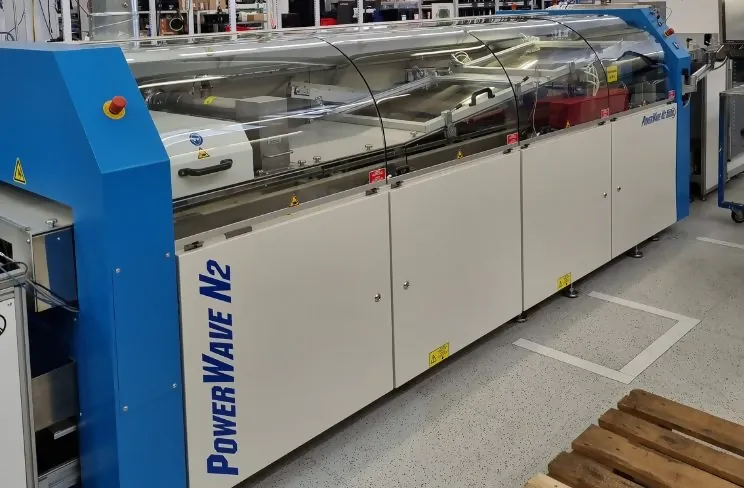
THT assembly and soldering processes
Both wave and selective soldering systems are available for THT processing. The choice of process is not standardised, but is determined by technical considerations based on the specific product requirements. Geometry, quantity and quality standards determine the process. This stage of the product journey, too, remains consistently focused on accuracy, reproducibility and long-term suitability for series production.
Once this foundation has been laid, a decision is made as to whether the product journey ends at this point or whether the expertise gained is used to build a complete system. In many projects, the next step is deliberately chosen and the product is transferred to the assembly process. Design, production engineering and project management continue to support the device during this phase and ensure that technical decisions are consistently implemented.
Assembly, integration and product-specific implementation
During the assembly phase, structures suitable for assembly are created, tailored to production volumes and product complexity. Assembly lines are designed to be stable, flexible and scalable. Standardised robotics is used for high volumes, whilst for products with a wide range of variants, manual or hybrid concepts with specific equipment are implemented. Processes such as casting, painting, ultrasonic welding or other product-specific steps are specifically integrated, always with a focus on quality, process reliability and repeatability.
What matters here is not so much the individual technology as the fundamental commitment to continuously developing products. Questioning processes, improving solutions and taking responsibility for the overall result also characterise this phase of the product journey. It is the interplay of clear structure, technical expertise and commitment that makes the difference.
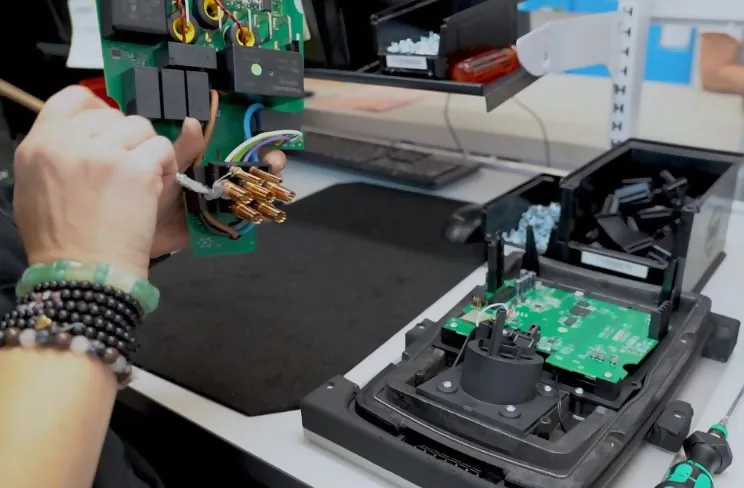
At the end of this product journey lies a system that is not merely manufactured, but has been thoroughly thought through and validated in its technical entirety. A product that originates from an environment in which development, production and industrialisation are closely interlinked and consistently geared towards mass-production readiness. A key factor here is the commitment to supporting products throughout their entire life cycle. At the Alpine Innovation Hub, STEINEL Solutions sees itself as a partner that creates solutions which work in the long term and make a lasting contribution to its customers’ success – from the initial idea to a market-ready system.

“Many challenges arise because crucial questions are asked too late. Our approach deliberately starts earlier – in collaboration with the client.”